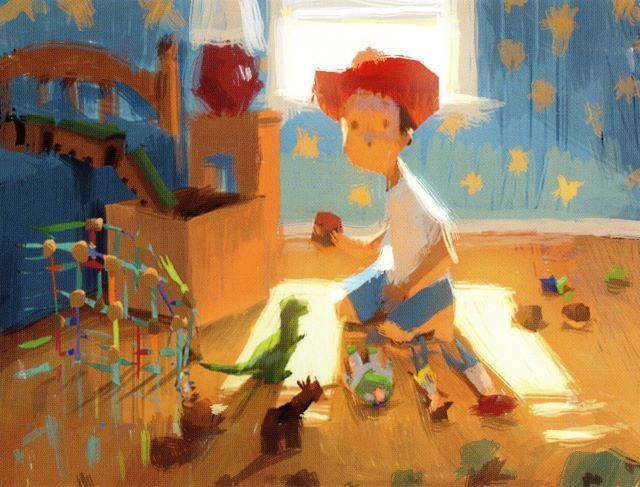
Daisuke Tsutsumi, also known Dice Tsutsumi, is LITERALLY my favorite artist in the animation industry. When thinking why, I figure it’s because his color keys somehow fill me with nostalgia. The way light interacts with each character and object makes a scene look lived in. It reminds me of days when I was young and playing with my toys, or when I was in college and walking across the campus on a fresh green lawn. His use of colors and textures are remarkably expressive. But this ability to have his art connect to his audience isn’t by happenstance – it’s completely his intent.


I was reading his interview with Portraits.jp, and it’s interesting how he regards art as an extension of real life. Many young artists, like myself, use art as a medium to escape from the world – to find a safe space where we can explore our own ideas. Dice, however, is interested in using art as a medium for connection. He stated in the interview that his interest in society was largely influenced by his father’s job as a political journalist. He would have discussions at home about society’s problems. I bet this shaped his unique approach to life – while most tend to avoid such topics, Tsutsumi embraces them. In the interview with the Japanese magazine, he frankly mentioned the Black Lives Matter Movement, saying, “Just like the death of George Floyd, by the time that someone has suffered and their pain is understood, it’s often too late.”
The very reason why he started to work at Pixar was that he felt that their work had a core purpose – to connect to the hearts of their audience. He went on to be involved as the lighting art director of Toy Story 3 (2010) and the color art director of Monsters University (2013). Also, apparently, he did a voice cameo as the sushi chef in Cars 2 (2011), which is SO funny for some reason.
After his many years of experience in the animation industry, he’s now at the point where he’s building a story true to himself. In 2014, he made a bold move. He and Robert Kondo, another former Pixar director, founded an independent animation studio called the Tonko House. Now is his chance to direct a story that connects his heart, to the hearts of his audience. That year, they released an animated short film called The Dam Keeper, a story centered around a lonely pig who discovers friendship with a newcomer. Even though he gets bullied at school, he is the only one in the town running the windmill and keeping a deadly dark mist from engulfing the town. Visually, the film is amazing! It’s made of over 8,000 hand-drawn paintings, and it looks like a picture book came to life. This film ended up being nominated for an Academy Award, propelling the studio to release more projects.

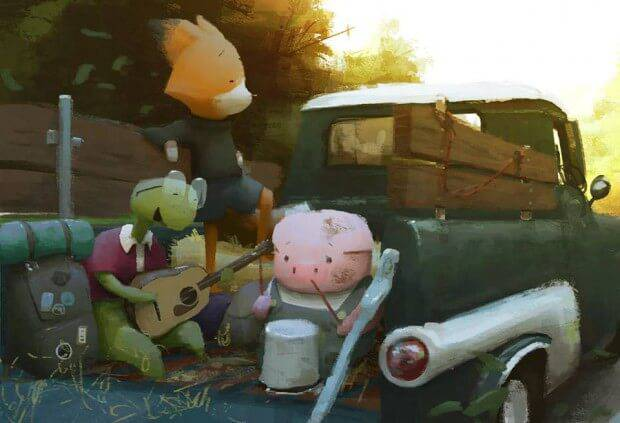
What made me most compelled when researching for this post was an interview posted by Creative Talent Network in 2018. In the early days of Tonko House, Tsutsumi had a particular creative process when conceiving ideas with co-director Robert Kondo. They hold “therapy sessions” where they take turns asking personal questions to one another, sometimes going so deep that they share things that even their wives don’t know. Sometimes this memory-sharing got painful. But by the end of a painful, vulnerable conversation, they were able to figure out the character of the “dam keeper.” It takes a special kind of strength to be willing to reshape a vulnerable moment into something beautiful that others can enjoy and relate to. His willingness to do so is what makes his artwork touch the hearts of many viewers.
Sources:
https://portraits.jp/sunpedia/2012.html